Mack & Schühle Italia Launches Dedicated Dealcoholisation Hub: The Pursuit of an Italian “Way” for No & Low Alcohol Wine – BASSO VOLUMESkip to main content
Mack & Schühle Italia Launches Dedicated Dealcoholisation Hub: The Pursuit of an Italian “Way” for No & Low Alcohol Wine
With a €4 million investment and an annual production capacity of 7.5 million bottles, the new plant utilizes the Italian “Libero Wine” technology by Omnia Technologies. The company is betting on process research and agronomical experimentation to lead the premium No-Lo segment.
Jessika Pini
17 April 2026
Tempo di lettura: 3min
dealcoholised wine, Fedele Angelillo, Mack & Schuhle, made in Italy, no-low, Omnia Technologies
The recent clarification of Italian regulations regarding dealcoholisation has triggered an immediate debate on the national approach to this burgeoning segment. The global market appears to expect an “Italian style” even in this category; therefore, it is a priority to define an Italian path that offsets the competitive disadvantage against countries that have already established years of R&D and commercial presence.
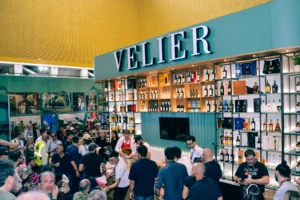
Mack & Schühle Italia, a leader in the production and distribution of Italian wines globally, is entering this debate by prioritizing technology and quality-oriented agronomical practices. The company has completed its own dealcoholisation plant in Laterza (Taranto) and presented its first samples at Vinitaly. M&S operates through two production sites in Italy: the Puglia facility in Laterza, dedicated to red wines and now the hub for dealcoholisation, and the Prata di Pordenone (Friuli Venezia Giulia) winery, which focuses on sparkling and still white wines.
Infrastructure and “Libero Wine” Technology
The dealcoholisation equipment represented an investment of €4 million, establishing a production potential of 7.5 million bottles per year. Furthermore, the existing facility underwent significant restructuring to integrate new bottling lines, which have effectively tripled previous production speeds.
The M&S facility is among the first fully operational plants in Italy to utilize the Libero Wine technique, developed by technical partner Omnia Technologies. The system involves an initial low-temperature osmosis phase to separate the “noble” components of the wine from the hydro-alcoholic portion. The latter is then distilled to remove the alcohol before the de-alcoholised water is reunited with the original organoleptic concentrate.
Market Strategy
The group’s approach aims to occupy the segment with a high-quality positioning, essential for competing with well-established foreign production structures.
“Quality is the true differentiator when approaching this market,” states Fedele Angelillo, Managing Director of Mack & Schühle Italia. “In the non-alcoholic beverage sector, we face competition from extra-Italian structures with which we cannot compete on cost alone. Therefore, we must remain rooted in the world of wine, focusing on ‘Made in Italy’ prestige and quality. We must also maintain a clear distinction between the No-Alcohol and Low-Alcohol categories. The latter is currently gaining significant consumer traction and helps producers remain competitive in export markets due to lower excise duties. Looking ahead, extending dealcoholisation to PDO wines is desirable to bolster the entire sector.”.
The development strategy excludes third-party bottling, focusing instead on range extensions for the company’s proprietary brands: Novantaceppi, Zardetto, Cà di Prata, and Grapur. For the latter, the company launched a low-alcohol (9% ABV) project in 2024 based on controlled fermentation (200,000 bottles). This range features sustainable packaging, including lightweight bottles (200g for still, 450g for sparkling) and closures made from Ocean Bound Plastic.
R&D and Varietal Focus
“At the end of April, we will begin a recipe-setting phase lasting several months,” explains Marketing Director Francesco Airenti. “Our goal is to bring de-alcoholised products to market that are qualitatively superior to the current global offering. If we are talking about 100% ‘Made in Italy’, we must immediately differentiate ourselves through quality.”
The initiative is part of a broader reflection on the evolution of the No-Lo category as a standalone segment rather than a mere production compensation tool. The objective is to scientifically investigate the oenological conditions that make a wine suitable for dealcoholisation, working with raw wine bases designed ad hoc. To this end, M&S has established an active collaboration with the Faculty of Oenology at the Università Cattolica del Sacro Cuore in Piacenza.
“The primary target channel remains retail (GDO),” concludes Airenti. “We are also working on a low-alcohol dealcoholisation project that allows us to produce a range with varietal designations. New regulations permit the labelling of international varieties such as Sauvignon, Syrah, Cabernet, and Merlot for de-alcoholised wines, and we intend to develop our new offerings specifically using these varietal bases.”